Categories
Uncategorized

Exploring Narrative Complexity through Analepsis in Westworld

My final paper focuses on Westworld’s season one finale and how the show presents narrative complexity throughout the season. For the sake of brevity and a focused blog post, I want to explore how the timeframe contributes to the show’s narrative complexity and work out some ideas that I have currently. Merriam-Webster defines analepsis as “a literary technique that involves interruption of the chronological sequence of events by interjection of events or scenes of earlier occurrence.” Rather than a conventionally linear sequence of time in which the narrative takes place, these “interruptions” with other events create multiple paths for the audience to track. Westworld embodies a similar structure in that it jumps around from protagonist to protagonist in each episode as they unravel aspects of the various mysteries inherent to the theme park. The analepsis functions in Westworld through two timelines, which the season finale reveals to the audience mid-way through the episode. The show preserves this secret because they only present as much information as the main characters are aware of in their respective storylines.

For example, the Man in Black (Ed Harris) is a mysterious, old, antagonistic figure who knew more information than the audience did, including the truth about the timeline and details about the multiple lives of the hosts(androids) such as Dolores’ past lives(Evan Rachel Wood). The plot twist involving the analepsis was that Dolores’ storyline was a memory because the Man in Black reveals that her love interest and do-gooder companion throughout the season, William (Jimmi Simpson), was the Man in Black when he was a younger man. The audience realizes from this new information that the show never explicitly defined a timeline and assumed that each event in the story was part of a linear storyline. According to Narrative Complexity in Contemporary American Television, analepsis functions by altering the show’s chronology creates instances of disorientation for the viewer through “a lack of explicit storytelling cues and signposts.” Even in the season finale, Westworld finds a way to add a new element to the story that recontextualizes how the audience watches and understands the show.

Suddenly, the timeline for each of the storylines comes into question, in that the audience is uncertain when each perspective occurred within the overall season chronology. Even the nature of flashbacks, another device under the umbrella of analepsis, becomes unreliable. Dolores unknowingly fabricated her storyline with memories of William from 30 years in the past, when in reality, she was using those memories of locations they visited to retrace her steps in the present day. It is an alarming revelation that the audience cannot trust their lens into the story, which creates uncertainty in how the rest of the episode will unfold. Analepsis as a narrative device through this specific instance creates a unique viewing experience that makes Westworld stand out as a narratively complex series.

Sources (informally cited, sorry)

https://www.merriam-webster.com/dictionary/analepsis

file:///Users/kirafarmer/Downloads/Mittell.Narrative%20Complexity%20in%20Contemporary%20American%20Television%20(3).pdf

Categories
Uncategorized

The Risks of Diminishing the Complexities of Race within the “Race-Horror” Sub-Genre

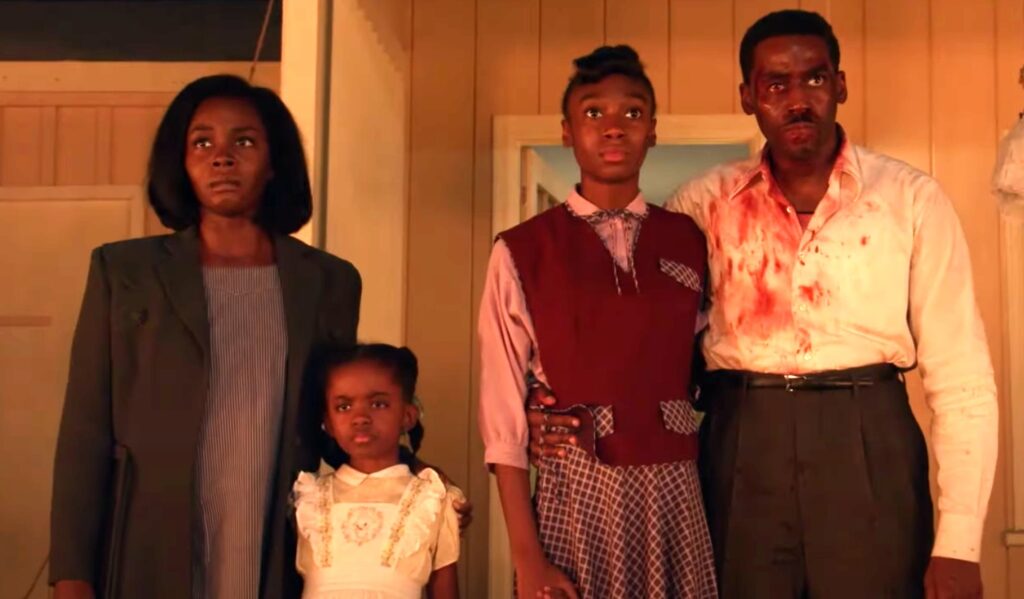
I remember seeing Amazon Prime’s Them (2021) trending on Twitter the day the first official trailer came out in March 2021, and after watching the 2-minute preview, I was immediately turned off and decided that I would never watch the show. IMDB describes the plot summary as “A Black family moves to an all-white Los Angeles neighborhood where malevolent forces, next door and otherworldly, threaten to taunt, ravage and destroy them.”1 The torture alluded to in this summary is very overt in the trailer. This includes depictions of white children howling like a monkey at the daughter character (Shahadi Wright Joseph), several anti-black caricatures known as Golliwogs2 hung by mini-nooses and littered outside of the family’s home, a “Sambo-Esque” character known as the “Da Tap Dance Man” that is meant to act as the supernatural force plaguing the family, and flashes of scenes in which the family appears to be tortured physically and psychologically throughout the series. This anthology series continues to develop the “race-horror” genre and the direction that projects within this genre could be headed. 

I am defining “race-horror” as a subset of the horror genre, which frames racism as the source of the horror that torments the protagonists who are people of color. When applying this definition to the show, I want to know how this visceral, horrific imagery functions as a message or theme other than the fact that black people have been physically and psychologically tortured by these devices and more for centuries in the United States? Or, in its most oversimplified form: racism is a horror story in itself that people should continue to be mindful of. I think that this intention is good by using this genre to inform and remind the general public of the horrific manifestations of racism, but using the horror genre to convey the message could go wrong at the same time.

I fear that future projects within the genre will grossly depict the most extreme methods of violent torture against their black characters to communicate the same message but offer nothing else. I find that the most provocative and compelling horror films are creative and create a unique circumstance in which well-known ideas or prevalent tropes are present, which results in a fresh, new addition to the genre. For example, I would argue a film like Jordan Peele’s Get Out (2017) meets the traits specific to this genre in which racism acts as a prevailing, evil torture device that enables white characters to kidnap, lobotomize, manipulate, and exploit black people for their gain. 

Many people assumed that Them was created by Jordan Peele because of his 2019 horror film Us (2019), which has a similar aesthetic in marketing and a black family as the protagonists. The danger of comparing these two pieces of media that fall within this “race-horror” genre is that Us is mainly a psychological thriller, in which the race of the black family is not pertinent to the subject of the film. Peele has even stated that the film “is not about race” despite the plot of his previous film, Get Out (2017), where the victims’ race was a focal point.3 On the topic of Jordan Peele, I believe that the popularity and discussion generated by Get Out contributed to the increasing recognition of this subsection of “black horror” within the horror genre. Racism was a prevalent idea that drove the plot forward, while the narrative was an inventive and clever new way to address these issues within the genre.

Them does not appear to be anything that I have not seen before, which makes me concerned for future projects within the genre. The broadest generalization of the plot seems to be a 50s white neighborhood tormenting their new black neighbors but taken to the absolute extreme. I have seen this era before in television and film, which shows the intertextuality between this piece of media and other historical texts/depictions about racism within this era of the country. Even these supernatural elements presented by “Da Tap Dance Man” is not compelling enough to subvert these ideas and tropes that are already a recognizable part of the cultural forum regarding the United State’s history of racism and the manifestations of that prejudice against black people. 

The reviews for the show have been mixed, with some reducing the show to being 10 hours of glorified “torture-porn” against the black characters and some arguing that the show is insightful and offers more psychological evaluations of the black family and white antagonists than it appears. There may be truth in both arguments, but I am fearful that future projects within this genre could reduce and overgeneralize these ideas to further torment black characters without adding anything new other than the message of “racism is a horror story.” Horror as a genre can torment the characters and terrify the viewers while also revealing some insight about the human psyche or present an inventive narrative. I think that is what the show is trying to accomplish, but I’ll determine that myself once I watch it.

Citations

1 IMDB. “Them.” IMDb. IMDb.com, April 8, 2021. https://www.imdb.com/title/tt9064858/. 

2 Jim Crow Museum of Racist Memorabilia. “The Golliwog Caricature.” The Golliwog Caricature – Anti-black Imagery – Jim Crow Museum – Ferris State University. Ferris State University, 2021. https://www.ferris.edu/HTMLS/news/jimcrow/golliwog/homepage.htm.

3 Obenson, Tambay. “’Us’ Makes a Radical Argument for Black Identity By Ignoring It.” IndieWire. IndieWire, March 22, 2019. https://www.indiewire.com/2019/03/us-movie-jordan-peele-lupita-nyongo-1202051703/. 

Categories
Uncategorized

Encoding That Depicts Toxic Relationships as “Romantic”

There are many instances in television where a fictional pairing displays harmful behaviors towards one another and the showrunners “rectify” these flaws by encoding a message to make the toxicity a part of their development throughout the series. Somehow, the dominant-hegemonic decoders in favor of the pairing will reframe the message and interpret it as a positive reading of the text. Examples of this include: Even though these characters did horrible things in the past, we can overlook it because they have changed for the better, or the actors have good chemistry meaning that I can ignore the relationship’s issues, etc. Granted, these are fictitious characters that technically have no bearing on the viewer’s livelihood when they do not consume the medium, so it may not matter how a relationship is portrayed to some decoders because it is still fiction. However, it is alarming how easily an encoded message can convince decoders to interpret the toxic relationship as romantic through a dominant reading.

What Game of Thrones Teaches Us About Content Marketing - AddThis

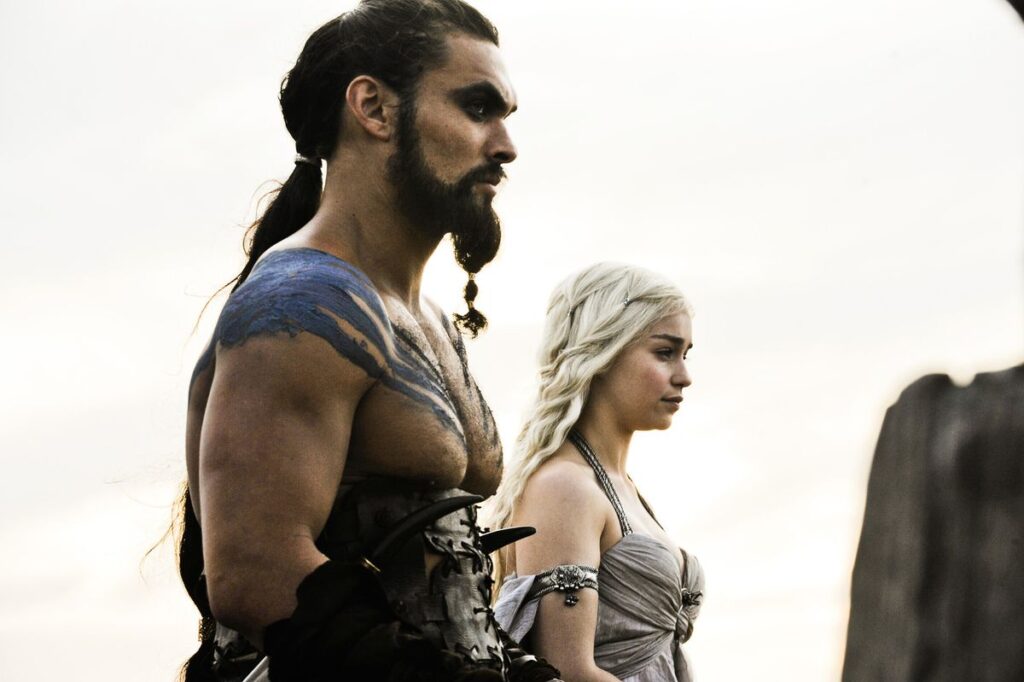
I recently came across an example of this in my first time watching Game of Thrones in their first season between Danaerys Targaryen and Khal Drogo. I found their relationship broadly resembling aspects of Beauty and the Beast. A “beastly” man holds a young girl captive as she sacrifices her freedom to protect the will of a family member. Their initial tumultuous relationship eventually blossoms into one of true love and mutual respect. These recognizable tropes are part of the message encoded by the storytelling to humanize Khal Drogo, empower Daenerys, and depict an endearing connection between an unlikely pairing. The message is supported by the actors’ electrifying on-screen chemistry and performance, which leads to a dominant reading of the material. Therefore, any disturbing scenes, implications, or issues present at the beginning of the relationship do not carry as much weight as the pairing’s “development” beyond those moments. When Danaerys puts Khal Drogo out of his misery at the end of the season, dominant-reading decoders are not only convinced that these two were in love but also feel robbed of more content between these characters on the show.

Instead of crying over the death of an “epic” couple, I spent the season debating on whether it was wrong to diagnose Danaerys with Stockholm Syndrome by falling in love with Khal Drogo despite his abuse of her. I understood the encoder’s message in terms of intention, the direction the relationship was heading, the actors’ work, and their story arc. However, I was not charmed by the relationship because of the horrific foundation it was built on. Through my negotiated reading, I could not overlook the influence of the fictional world’s social norms and how they played a significant role in the relationship. Their society dictates that women must be docile and subservient to their husbands and are exchanged with neighboring kingdoms in exchange for establishing alliances, building a family legacy, or, in this case, procuring an army. Part of this social dynamic is that the women have no choice but to make the best of their situations regardless of their initial displeasure or lack of consent for said exchange.

At the start of the season, Danaerys did not want to marry Khal Drogo but forced to do so because it was the only way for her brother to get an army to reclaim the iron throne. After the trade-off, Khal Drogo raped her on multiple occasions. These scenes of sexual assault communicated an image of helplessness through the acting choices, dialogue, and explicit, negatively charged visuals. To convince him not to rape her again, Danaerys had to use her body to appease Khal Drogo’s sexual desires and present her willingness to lie with him moving forward. That scene marked the beginning of their so-called “development” they receive for the rest of the season. These scenes between them make it impossible for me to take a dominant-hegemonic position on their relationship because of how torturous it was for Danaerys and how one-sided it started. 

Perhaps various readings of this relationship are dependent on what the decoders are most attentive to and viewing preferences that they tend to gravitate to. Maybe the actors’ performances were alluring and appealed to a collective of the dominant readings decoders. Or they enjoy an unlikely pairing turned power couple midway through the season. An oppositional reader may find the power dynamic socially unacceptable and misogynistic. As the negotiated reader, I can acknowledge the triumphs of the storytelling and the performances and disliking the foundation for their love based on the roles of the social norms and pressures that could have influenced her development. Each decoder’s viewing experience will be unique to them in some regard, which will influence their reading of the text. I cannot fathom how people could like pairings that share similar distasteful attributes(I know they’re out there), but thinking about each groupings perspective through encoding and decoding is an interesting mode of interpretation to consider when watching any television.

css.php