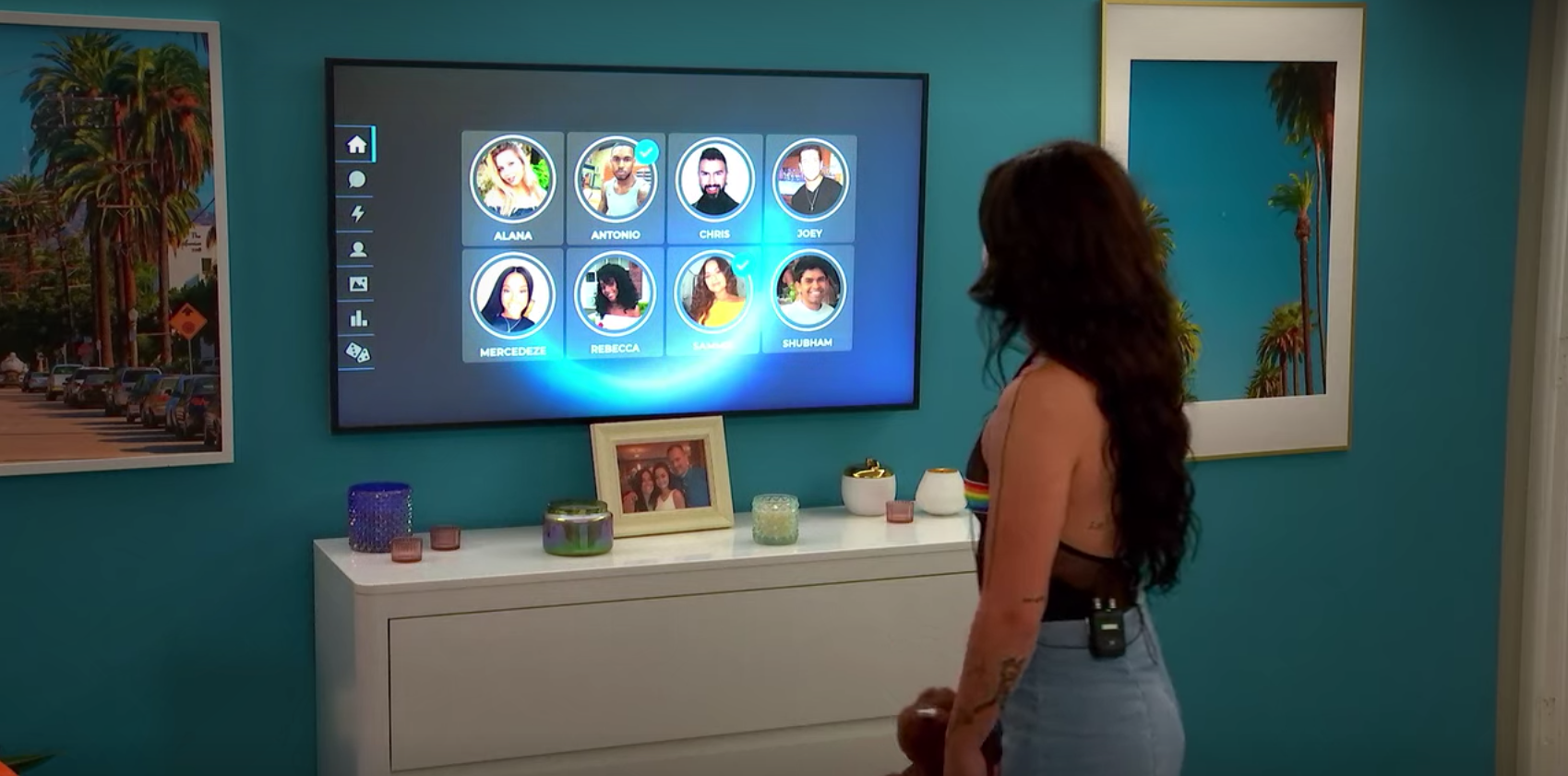
Television provides its viewers with a form of escapism from the real, sometimes by way of introducing them to a new real. That’s right, I’m talking about reality TV. As part of our research for our final project, my group agreed to watch an episode or two of The Circle on Netflix. I, however, watched the first season within a week. I’ve always been a reality TV naysayer, but something about The Circle had me hooked and I’m trying to figure out just what exactly this thing is.
On The Circle, contestants cannot see or hear each other, but communicate via a faux social media platform, ranking each other each night. Ultimately, one player gets blocked, aka sent home, until there are only a handful left. Maybe it is because of the pandemic, or maybe it is just because this is just what communication looks like these days, but I found this to be a surprisingly relatable show…to some extent.
After watching a few episodes one night, I (finally) turned off my laptop and picked up my phone to respond to my friends’ texts. While I was typing, I noticed that I was doing so with the mindset of being on The Circle. At first I was concerned and slightly horrified by this, but now I’m not so sure if my caution was a bad thing. Gray makes the point that we are living in a textual world (3). Our phones give us direct access to these texts, a level of accessibility that enables us to go through our days without actually considering the hidden messages media sends to us via Instagram, Twitter, and the news, let alone our interaction with these texts via our own actions.
When I was replying to my friend, I was very aware of the text that I was sending and how the message/intended tone was going to impact the receiver’s perception of me. The Circle 100% stimulated this response from me which supports Gray’s first form of intertextuality: influence. Influence, he argues, is a one-way interaction where texts affect us to the point that our future actions will be influenced by the original text (4). For me, watching The Circle altered my perception of social media and how I use it in my personal life, but I cannot use that lens to analyze The Circle itself. Despite The Circle’s access to my home and life via Netflix, it will always remain a distant, intangible thing.
Johnathan Gray wrote in “Intertextuality and The Study of Texts” that “Intertextuality theory provocatively asks us to what degree a text as entity can exist outside of itself as a physical object and live through other texts. The 2006 movie musical, High School Musical, is arguably Disney Channel’s most popular movie and with such a large fanbase means the movie has existed and been referenced in several Disney Channel shows like The Suite Life of Zack and Cody. Then in 2019, the degree that this entity could exist was pushed and taken to a whole new level when a show was made on Disney+ based on the movie called High School Musical: The Musical: The Series (HSMTMTS).
No, it’s not a cheesy reboot. It’s a series with a lot of intertextuality. The school where High School Musical was filmed is actually a real school in Salt Lake City, so the series is a mockumentary about the real East High’s drama department putting on High School Musical for their seasonal production. The casts cover songs from the film and the last episode of season one is the opening night of the show. The series may seem like a copy of the movie, but the show has its own storyline, characters, love triangles, and songs. The film is referenced and intertwined with the theater kid’s lives, but overall, HSMTMTS is its own entity outside of High School Musical. To separate itself from the film, each episode has two songs: 1) a cover from High School Musical and 2) an original song. For example, in the sixth episode of season one “What Team?,” the drama teacher is on leave when the school board makes accusations about her teaching credentials. Carlos, the student choreographer, has to take over rehearsal for the day. The students argue over the High School Musical scene where Gabriella sings “When There Was Me and You” and how to bring the film scene to the stage. Ricky covers the song to show another character how he thinks the performance should be done on stage. Later in the episode, everyone finds out about the drama teacher potentially losing her job, and they show up to the hearing and sing an original song called “Truth, Justice, and Songs In Our Key.”
This episode is a great example of why HSMTMTS is an example of intertextuality and not a reboot. The show has its own storyline, but incorporates the text of High School Musical into its plot. As Gray would say, the film “lives through” the series. The second season shows the drama club producing Beauty and The Beast (which makes the title of the show confusing), so now instead of a season with intertextuality of High School Musical, its Beauty and The Beast songs that will be covered and references that will be made.
Before I downloaded TikTok, I felt like there were so many references I was missing out on. Everything from popular songs, to dances, to clothing styles, and lifestyle aesthetics seemed to spawn from this app that I honestly had no interest in downloading. However, I eventually gave in and downloaded the app for the sake of my friends who wanted to send me funny videos. Due to the scarily accurate algorithm, I became addicted to the app quite quickly. After spending a significant amount of time on the app, I realized how internal the content is, and how much of the content heavily relies on past trends and previous viral videos. Many of the TikToks that I see are based on another sound or trend, and sometimes even basic knowledge of the original post is needed to fully understand the video. Much of the content produced does not exist in a vacuum, and it is very internal to the app itself. For example, TikTok dances are created by a creator, sometimes with a large following and sometimes not, and then other creators see the original video and do the same dance to the same song. Although some viewers might not know where the original dance comes from, the content does rely on earlier work that is specific to TikTok. Below is an example of a TikTok dance being performed by a popular creator, Charli D’Amelio. Although a knowledge of the original video with the creator of the dance is not needed to understand the video, Charli does tag this original creator, and both the song and the dance are taken from this video.
Gray’s theory of intertextuality was used to describe television, but it can also be applied to TikTok. Gray makes reference to the existence of ghost texts, which “come from the reader, and other texts they have encountered” (Gray 27). Knowledge of previous texts is crucial to understanding some of the content on TikTok. From my time on the app, I have noticed that TikTok tends to go through songs, dances, and trends quite quickly, and then circles back to them in the spirit of nostalgia. However, this only works if the people viewing the nostalgia video have at least a general knowledge of the video(s) being referenced. An example of this is a TikTok posted a day ago, which is essentially just a block of text and the song “Roxanne” playing in the background.
The text says that this song reminds them of TikTok in 2019, as well as how the world was at that time this song was popular on Tik Tok, which includes things such as rainy fall days, TikTok still being lowkey and no Covid. To me, someone who was not on TikTok at the time, this song does not correlate to these things. However, this creator is relying on the many people who were and who heard this song constantly in the fall of 2019 to associate this song with those things and be nostalgic about it. Clearly, this worked, as the comments are full of people saying they miss it, and the video has over 500,000 likes. This text is entirely contingent upon the presence of ghost texts, as they need the viewers to at least have a partial memory of TikToks they saw with this sound in the fall of 2019 to understand the video.
Not all of TikTok is so heavily reliant on ghost texts, but TikTok has a whole is very internal with its trends, and many TikToks do rely on each other to keep the content flowing.
We’ve discussed this week about the concept of intertextuality and paratext. And as is painfully obvious with Hollywood these days, no fictional work is completely original; all fictional narratives of the past and present are in dialogue with each other, and any individual piece is defined by more than itself. How we perceive any given piece can changed – and therefore the piece itself can by further defined – by its advertising, its era, and even other movies/shows. What if I was to tell you that Die Hard was one of my favorite comedies ever made? No, I’m not talking about the Bob’s Burgers‘ Die Hard, I mean the actual, 1988, Bruce Willis movie Die Hard. Let me explain.
Now some of you may immediately think that I am going to bring up how Bruce Willis was known for being a sitcom actor at the time, and how people thought he was a strange choice to be cast in such a grounded, ultraviolent action thriller. All of that is completely valid and I’m sure has effect the viewing of this arguably genre defining classic for people of my parents’ generation, but in this case, I as well as surely many of you have known Bruce Willis all my life as an action star. That alone had no effect on my viewing experience. However, here’s a little tidbit that just might shock you: did you know Die Hard is actually based on a novel? It’s a relatively obscure novel called Nothing Lasts Forever. If you haven’t read the novel, don’t worry, I haven’t either. All you need to know about this book is that it is a sequel to the novel The Detective. All you need to know about that book is that it was adapted into a 1968 film of the same name. All you need to know about that film is that it starred Frank Sinatra – yes, that Frank Sinatra. Why is this important? Well if your parents thought Bruce Willis was an odd choice for Die Hard, take a gander at this: before going into production the studio was contractually obligated to ask Sinatra if he wanted to star in it.
Now the next time you watch Die Hard, all you’ll be able to think about is how silly it would have been if Frank Sinatra was in Bruce Willis’ place.
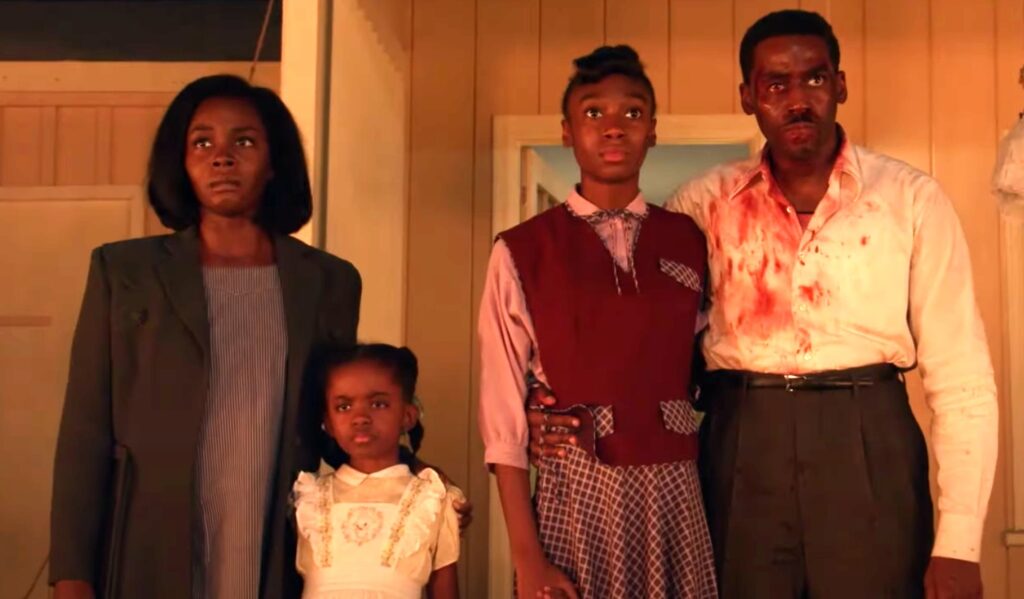
I remember seeing Amazon Prime’s Them (2021) trending on Twitter the day the first official trailer came out in March 2021, and after watching the 2-minute preview, I was immediately turned off and decided that I would never watch the show. IMDB describes the plot summary as “A Black family moves to an all-white Los Angeles neighborhood where malevolent forces, next door and otherworldly, threaten to taunt, ravage and destroy them.”1 The torture alluded to in this summary is very overt in the trailer. This includes depictions of white children howling like a monkey at the daughter character (Shahadi Wright Joseph), several anti-black caricatures known as Golliwogs2 hung by mini-nooses and littered outside of the family’s home, a “Sambo-Esque” character known as the “Da Tap Dance Man” that is meant to act as the supernatural force plaguing the family, and flashes of scenes in which the family appears to be tortured physically and psychologically throughout the series. This anthology series continues to develop the “race-horror” genre and the direction that projects within this genre could be headed.
I am defining “race-horror” as a subset of the horror genre, which frames racism as the source of the horror that torments the protagonists who are people of color. When applying this definition to the show, I want to know how this visceral, horrific imagery functions as a message or theme other than the fact that black people have been physically and psychologically tortured by these devices and more for centuries in the United States? Or, in its most oversimplified form: racism is a horror story in itself that people should continue to be mindful of. I think that this intention is good by using this genre to inform and remind the general public of the horrific manifestations of racism, but using the horror genre to convey the message could go wrong at the same time.
I fear that future projects within the genre will grossly depict the most extreme methods of violent torture against their black characters to communicate the same message but offer nothing else. I find that the most provocative and compelling horror films are creative and create a unique circumstance in which well-known ideas or prevalent tropes are present, which results in a fresh, new addition to the genre. For example, I would argue a film like Jordan Peele’s Get Out (2017) meets the traits specific to this genre in which racism acts as a prevailing, evil torture device that enables white characters to kidnap, lobotomize, manipulate, and exploit black people for their gain.
Many people assumed that Them was created by Jordan Peele because of his 2019 horror film Us (2019), which has a similar aesthetic in marketing and a black family as the protagonists. The danger of comparing these two pieces of media that fall within this “race-horror” genre is that Us is mainly a psychological thriller, in which the race of the black family is not pertinent to the subject of the film. Peele has even stated that the film “is not about race” despite the plot of his previous film, Get Out (2017), where the victims’ race was a focal point.3 On the topic of Jordan Peele, I believe that the popularity and discussion generated by Get Out contributed to the increasing recognition of this subsection of “black horror” within the horror genre. Racism was a prevalent idea that drove the plot forward, while the narrative was an inventive and clever new way to address these issues within the genre.
Them does not appear to be anything that I have not seen before, which makes me concerned for future projects within the genre. The broadest generalization of the plot seems to be a 50s white neighborhood tormenting their new black neighbors but taken to the absolute extreme. I have seen this era before in television and film, which shows the intertextuality between this piece of media and other historical texts/depictions about racism within this era of the country. Even these supernatural elements presented by “Da Tap Dance Man” is not compelling enough to subvert these ideas and tropes that are already a recognizable part of the cultural forum regarding the United State’s history of racism and the manifestations of that prejudice against black people.
The reviews for the show have been mixed, with some reducing the show to being 10 hours of glorified “torture-porn” against the black characters and some arguing that the show is insightful and offers more psychological evaluations of the black family and white antagonists than it appears. There may be truth in both arguments, but I am fearful that future projects within this genre could reduce and overgeneralize these ideas to further torment black characters without adding anything new other than the message of “racism is a horror story.” Horror as a genre can torment the characters and terrify the viewers while also revealing some insight about the human psyche or present an inventive narrative. I think that is what the show is trying to accomplish, but I’ll determine that myself once I watch it.
Citations
1 IMDB. “Them.” IMDb. IMDb.com, April 8, 2021. https://www.imdb.com/title/tt9064858/.
2 Jim Crow Museum of Racist Memorabilia. “The Golliwog Caricature.” The Golliwog Caricature – Anti-black Imagery – Jim Crow Museum – Ferris State University. Ferris State University, 2021. https://www.ferris.edu/HTMLS/news/jimcrow/golliwog/homepage.htm.
3 Obenson, Tambay. “’Us’ Makes a Radical Argument for Black Identity By Ignoring It.” IndieWire. IndieWire, March 22, 2019. https://www.indiewire.com/2019/03/us-movie-jordan-peele-lupita-nyongo-1202051703/.
This might seem like a strange question to ask, but definitions are incredibly important in analyzing a medium, particularly when it comes to edge cases and the introduction of new information or technologies that fundamentally change our understanding of the original definition.
I know this is cliche, but bear with me. Merriam-Webster defines “Television” as:
“an electronic system of transmitting transient images of fixed or moving objects together with sound over a wire or through space by apparatus that converts light and sound into electrical waves and reconverts them into visible light rays and audible sound”
With that working definition, our understanding of “television” is quite broad. Netflix fits the bill, but so does Snapchat, TikTok, and Instagram. However, we don’t generally consider Snapchat TikTok or Instagram to be “television” which leaves us searching for a more cultural definition / understanding of the medium. I’ll shelve Netflix for now, but we’ll get back to that.
While this rigid technical definition of “Television” exists, it is certainly not the metric most people use to describe their viewing habits and media engagement. For now at least, most people still consider “television” to involve a TV set, a cable box, a viewing guide, etc. Just like the rigid textual definition, the more nuanced cultural definition of television revolves around the technology that enables such viewing. For a while, the technological evolution was in step with the cultural understanding of the medium. Yes, increasing access and new technologies like DVR changed our interaction with the content, but the form remained largely unchanged. Television was still premised on the presence of a TV, and the cultural experience – our cultural understanding of “television” – was still rooted in vestigial viewing patterns from the early days of the medium. Recently, however, technology has uncoupled itself from these vestigial patterns and understandings, allowing us to consume much the same content in an entirely different form.
This finally brings us to the question: Is Netflix Television? From the technical definition, it certainly is, however we need to look at the cultural elements, the nuanced empirical understanding of the medium. For starters, Netflix has a large technological overlap with traditional television – many people still watch Netflix on a smart TV or a Roku-like device that piggybacks on the traditional form. It’s very much still an “event,” friends still have “watch parties” and look forward to new releases on the platform. Finally, the content is largely identical to the content of “traditional” television, which begs the question “what’s really so different?” Is it possible to be consuming TV shows, without “watching television?”
Netflix is fundamentally different from traditional television in three respects. Firstly, Agency on the platform is unparalleled in comparison to any other medium. Not only can you search for a specific show and watch it any time you like, you also get to enjoy it uninterrupted by ads. Second, while primarily a consumption platform, Netflix has also begun producing original content in a way that questions the longstanding roles established in the industry. It’s the equivalent of a Samsung starting a studio, or Kitchen-Aide starting a meal prep service. Even writing these examples, they seem frankly quite probable, where even 10 years ago it would be absurd. You see this breakdown of established roles in the music industry as well, where another streaming platform – Spotify – is also beginning to produce original work and alter the content → consumption pipeline. Finally, the last major difference between traditional TV and Netflix can be found in temporal limitations. Despite all these notable achievements of the platform, it does lack one thing that traditional television still provides: live coverage.
News coverage and sporting events are two niches that Netflix – for now at least – can’t accommodate. There are other streaming platforms, largely network-provided, that do provide these services, but network news and sporting events are the final holdouts for traditional television as we understand it. However, as more streaming platforms emerge, it will only be a matter of time before these content niches are absorbed in a similar fashion as network television. We’re still in a state of flux, navigating much of the same content through an entirely new form, but using perhaps antiquated terminology from that historic form to describe our experience. With the rate of technological innovation, it won’t be long before Television refers simply to the technology – a physical TV screen – rather than the experience of the medium.
Note: I wrote this post a week ago, but accidentally locked myself out of my account (very smart). Now that I have posting privileges again, here is my submission.
On its surface, TikTok may seem like a meaningless social media time suck, designed for materialistic 12-year olds and influencer teens with bright teeth and ridiculous houses. However, plenty of media critics have begun to pay attention to the ways Tik Tok is interacting with culture (see: Hannah Giorgis’ article on the importance of 2020 election satire).
With this in mind, I would like to talk about a particular genre I have observed on TikTok, and how I believe it may be understood using Ellen Seiter’s essay on semiotics. In the tradition of many media critics before me, I have decided to make up a nonsense term to describe this minute phenomenon that only I care about, which I am calling “scene layering”.
In this tradition, creators take an audio clip of some form of content (usually a snippet of a TV episode) and add another layer of meaning to convey their own message. In particular, I would like to focus on a 15-second clip from the Season 4 Episode 10 final of The Crown, a Netflix Drama series about the British monarchy.
The clip is from a fight between Prince Charles (son of Queen Elizabeth) and his young wife, Diana the Princess of Wales. A fictional retelling of a real-life relationship, The Crown has found success by re-igniting and reintroducing a public obsession from more than 25 years ago to a new generation of viewers. In the scene (included below) Charles has just finished yelling at his wife for being rude to his mistress Camilla, (???) and tells her that she is his priority, not Diana (yeesh.)
As the cropped video informs, both actors Josh O’Connor and Emma Corrin were nominated for (and have now won) a Critics’ Choice award for Best Actor and Best Actress. (The Crown itself has been nominated for awards a mind-boggling 142 times.) The comments are full of fans gushing about their performances and loving/hating their real-life counterparts. However, this audio has now had a second life, as seen in the clip below.
A Tik Tok creator adds a layer of personal commentary
Content creators have picked up on the raw emotionality conveyed in the scene in order to express their individual thoughts on other media or funny personal conflicts in their own lives. Clearly this technique of “scene layering” has struck a chord with an audience—at the time of this writing, this video has been watched almost 800,000 times. But the trend is not just for personal anecdotes. In the second example below, the audio is used as a vehicle for fan discourse another popular show.
Just as Seiter suggests, there is “no natural or necessary connection between… the signifier and the signified.” (33) In fact, when writing this post, my roommate commented that she loved the audio, but had no idea where it came from! Yet, she still managed to understand and enjoy the trend.
If we understand the audio clip to be the signifier, then perhaps the signified is the raw, emotional conflict about something completely different. I believe that this “scene layering” allows its creators to change the meaning of the original sign into something softer, comedic, and personal. Of course, understanding these terms is no easy task, and I welcome the thoughts of others. Is my characterization correct? Does the analysis translate?
So this is just me going to be talking about an episode from a show I particularly like called Tales from the Crypt. It was a rather crude, raunchy anthology series in the late 1980s and early 1990s that was also a send up to pulp horror comics from the 50s, specifically of a magazine originally called The Vault of Horror which later was retitled – you guessed it – Tales From the Crypt. You’ll see why I bring up this bit of background knowledge later. As for the tv show, like I said it’s an anthology so the stories follow no continuity, but the one element that links them all together is that they are hosted by a Gollum looking fella with an appetite for horror related puns called the Crypt Keeper. What is interesting is that there is an episode called Lower Berth in which two circus attractions (a boy with literally two faces and an undead mummy) give birth to a child at the end and that child is the Crypt Keeper. This I can’t figure out which type but I do believe is some form of narrative complexity but by breaking the standards of the show’s own narrative, rather than the show’s general narrative breaking standards of television. You see, this is the only episode where the Crypt Keeper’s existence is acknowledge within the stories he presents to us. And at first I was going to say isn’t it crazy that they had this kind of narrative complexity from a comic book back in the 50s? But then it hit me. Wait a minute, the original comics did not have a host. But the Crypt Keeper shows the cover of the corresponding comic just like always at the beginning of Lower Berth, so this is based on an existing comic, but how random would it be for the writers of the comic to make up some character called the Crypt Keeper for this one issue and have that, a character no one’s ever heard of before, be the big twist at the end. So I did a little research and what I found was 1) No, the original comics had no host, let alone the Crypt Keeper 2) Yes, the original comic did end with baby Crypt Keeper (my new baby yoda btw) as the big twist HOWEVER 3) The Crypt Keeper was in fact around before this issue so die hard fans would have known who he was. Apparently he was not as strongly associated with the Tales from the Crypt comic series, but he did make occasional appearances and his first appearance was in a eerily similar named issue of a comic series called Crime Patrol: The Crypt of Terror. It’s interesting isn’t it how such a little change in an adaptation, an otherwise faithful one no less, of some preexisting work can lead to such drastic shifts in the nature of something like the narrative?
The sitcom format is one of the longest standing television formats ever. Popularized in the mid 1900s by shows like I Love Lucy, The Adams Family, and All in the Family, this format is made up of predictable characters, relatively stagnant relationships between characters, and a return to normality at the end of each episode. This return to normality is the idea that there is: 1. a base starting point of each character at the beginning of the episode, 2. a moderate conflict introduced to the world of the show, and 3. a resolution of this problem at the end of the episode with the characters returning to their original starting point of normality. This allows for audiences to pickup on whatever episode they please without any plot confusion.
While Bojack Horseman adheres to certain elements of this sitcom format (length, character driven plot, and general episodic format), the show strays from this traditional sitcom mold by eliminating this return to normality. Over the course of the show, characters make many mistakes (sometimes drastic ones), but these mistakes rarely get resolved at the end of the episode. We even see the consequences of Bojack’s actions in season 1 come back to bite him in the final season of the show. This theme of actions having consequences also takes form by altering the relationships between the show’s central characters, something that rarely happens in traditional sitcoms. Another key difference from traditional sitcom characters is that the characters actually WANT to change and be better.
The show becomes very meta with this sitcom comparison through the use of the fictional 90’s sitcom Horsin’ Around that Bojack starred in, giving his acting career life. We often see Bojack rewatching his old sitcom at some of his darkest moments in the show, giving him this happy escape from reality that sitcoms are supposed to create. This juxtaposition between the happy Horsin’ Around’ sitcom world and the often dark and depressing world of Bojack Horseman shines a light on the unrealistic reality of almost all sitcoms. Through this, despite being an animated world full of talking animals, Bojack Horseman is able to create possibly the most realistic picture of reality of any sitcom ever.
Before the start of the Unprecedented Times, I was never much of a reality TV gal. My friends in high school would talk about what happened on the Bachelor, and I’d sit there and smirk. I placed in the top 5 of a game of Survivor in my hometown that one of my fanatic friends put on to use as leverage for a Survivor casting call–I still have yet to watch an episode.
In early 2020, I started watching Love is Blind, and that show really carried me through the initial stages of “oh shit something bad is about to happen but nobody knows what.” Fast forward to April 2020–a month I don’t remember at all, other than the shows I started watching: The Bachelor (Listen to Your Heart spinoff), Too Hot to Handle, The Circle, Love Island (Australia!).
The thing these shows have in common is their ability to lower my brain function to zero so I can be ready to interact with the world’s 100. But I’d argue that the premise of all these shows are vastly different, and that’s why I jumped from one to the next.
In thinking about Mittell’s “genre studies should negotiate between specificity and generality” principle, it’s clear that reality TV is a genre that has 1) recently emerged 2) rapidly changed in the short time it has existed. Back in the day, it seemed like Survivor/Big Brother, Jersey Shore, Cake Boss (and other TLC shows) were the objects of interest, and today? There are so many options that fit under the “reality TV” umbrella. Now, we are seeing a reality TV universe: think about the overlap between previous and present Bachelor (franchise) contestants; this new season of The Circle features the winner from Too Hot to Handle–completely different shows, with the same loud and obnoxious contestants.
SurvivorToo Hot to Handle
It goes to show a paradox in Mittell’s diagnosis that genre surpasses the bounds of any singular text. On one hand, Love Island is undoubtedly a reality TV show, but can it be categorized with Survivor? I guess both incorporate islands…but then what about Love is Blind? Or even Bachelor with singers and artists as opposed to “normies?” Should we start to further specify reality TV categories, or is the unbounded potential for different show premises precisely what makes it “reality?” Will people really do anything for a little clout? These are questions I’ll ponder as I start a show called Dating Around.